
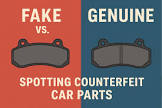
Executive Summary
You can usually tell an original car part from a fake by checking four things together: The part number matched to your VIN, the consistency of the packaging across several units, the weight and finish of the part in your hand,whether the seller will put the brand, part number and warranty on a written invoice. None of these proves anything alone, but when all four agree you are on solid ground. Here is how to identify original car parts without being a mechanic and how to buy so you have proof later if something goes wrong.
Core Factor
- Genuine means made by or for the vehicle manufacturer to their specification,aftermarket parts come from other companies and range from excellent to poor. Counterfeit parts copy a brand without permission.
- Your VIN not the model name ,is what pins down the correct part.
- Packaging and holograms are weak signals on their own,weight, design casting outlook and how the part number is applied are stronger.
- The cheapest quote is not automatically fake while the most expensive is not automatically genuine.
- A written invoice showing seller, date, brand, part number and warranty is your real protection.
- Never gamble on brakes, steering, airbags, suspension, fuel or high-voltage electrical parts. Those belong with a qualified mechanic.
What “Original” Really mean
The word “Original” gets used loosely at parts counters, so it helps to know the three categories you are actually choosing between.
Type What it is What to expect Genuine / OEM Made by the vehicle manufacturer or by a supplier working with their specification, sold under the car maker's brand or the supplier's own brand. Correct fit for your exact model, year and variant, consistent quality,usually a warranty from the maker or supplier. Aftermarket Made by a company that is not the original supplier, but built to fit the same application. Quality varies widely. Some aftermarket firms are the very suppliers that make OEM parts. Brand reputation is your main guide. Counterfeit An unauthorised copy carrying another company's brand or part number, dressed up to look genuine. Unknown materials and tolerances, no real warranty, and a trademark problem on top of a quality problem.
Note that a part being genuine does not make it indestructible. Correct parts can be defective or covered by a recall, and a good part fitted badly can fail early. That is a different problem from a fake and it is worth keeping in mind before you blame the part.
How To Identify Original Car Parts Before You Pay
Start with the vehicle Not the shop (E Get Why)
Get the VIN from the chassis plate or your documents and note the engine size, transmission or trim. Photograph your old part from several angles, including any number stamped or cast on it. If a seller asks “which one?”, you now have a proper answer instead of a guess. You can check the VIN for free on DealCentral.ng to confirm what your car actually is. This matters in Nigeria because so many cars are imported used: two vehicles that look identical on the outside may take different parts underneath (understand this and have peace of mind).
Choose The Product Grade On Purpose
Decide before you reach the counter whether you want genuine OEM, a reputable aftermarket brand, or a good used genuine part know as TOKUNBO which originates from a donor vehicle. Write the choice down. The common mistake is deciding by price alone while standing at the counter with the car already on the ramp or rushing the fixing.
Ask the seller these questions
- Which brand and part number is this, exactly?
- Will you write the brand and part number on the invoice?
- What is the warranty,who honours it?
- What happens if it does not fit — can I return it?
- Can I see a photo of the actual part and its label, not a catalogue picture?
Ask in writing where you can, especially with online and social-media sellers. A straight seller answers these questions easily and is not offended by them.
Compare Several Unit Of The Same Item
Ask to see two or three of the same part,genuine stock is consistent: same font, same colour shade, same seal, same batch or date coding and same label position (no magical surprises lol). Counterfeit stock often varies from copy to copy,look for spelling errors, thin or flimsy board, a box that has been re-glued and a label stuck over another label.
Handle the part ( Compare and Contrast)
Weigh it against the old one in your hand,a brake disc, filter or suspension arm that feels noticeably light is worth a conversation. Look closely at castings and mouldings for sharp edges, flashing, porosity or paint sprayed over grit. Check the machining on brake surfaces, the thread quality on bolts and studs whether a bearing rotates smoothly. Flex rubber parts hard or perished rubber on a “new” item is a bad sign. On electrical parts, match the connectors: pin count, keyway shape and colour should be identical to what came off the car. Where you can, dry-fit without forcing anything,mounting holes should line up without drilling or filing.
A Practical Checklist To Run At The Counter
- VIN confirmed and the part number checked against your exact model, year, engine and trim.
- Brand named on the box, the label and the invoice.
- Part number appears on the part itself or on a label that is not easily peeled off.
- Two or three units compare the consistent in print, seal and coding.
- Weight and finish compare with the old part.
- Connectors and mountings match the original.
- Warranty and return terms explained before you pay.
- Invoice written with seller name, date, brand, part number and warranty.
- Photos taken of the label, the part number and the receipt.
- Safety-critical items booked in with a qualified mechanic for fitting.
Warning Signs-Never Ignore
- A part number that exists only on a sticker you could peel off in one pull.
- Print that is blurry, off-colour or misspelled, or a box that feels lighter and flimsier than it should.
- A seal that has been cut and re-glued, or a label stuck over another label.
- A price that sits far below every other quote for the same brand,ask why before you celebrate.
- No business name, no fixed address and no receipt, only a phone number and a promise.
- Reluctance to let you compare two units or to photograph the label.
- A part that needs filing or drilling to fit. Genuine parts are made to fit.
Parts You Should Never Gamble On
Counterfeit risk concentrates where volume is high and the price gap is tempting: filters, brake pads,spark plugs, wipers, bulbs, shock absorbers, bearings, belts, lubricants and high-value items such as lamps and airbags. Some of these are inconvenient if they fail. Others are dangerous. Brakes, steering, airbags, suspension under load, fuel system components, and the high-voltage systems in hybrids and electric cars should always be sourced and fitted through a qualified mechanic, and never tested on the road to see whether they hold. If you are unsure about anything safety-related, check our road safety tips before you drive.
The Paperwork And The Fitting Matters As much As The Part
Buy from someone traceable: a business name, a physical address, a phone line that is answered and a written invoice. Keep the packaging, Photograph the label, the part number and the receipt.Store them where you can find them easily.
After fitting, note the date and mileage, keep the old part for a while, and keep the warranty card with the invoice. If something fails early, that record is what turns a complaint and into a claim. It also helps to know your rights as a buyer before a dispute starts rather than after.
Finally, remember that fitting standards vary,a genuine part installed without the right torque, the right fluid or the right alignment can fail early and feel exactly like a fake. If a repair goes wrong, ask the mechanic to check the installation before you conclude the part was the problem.
Buying car parts in Nigeria rewards preparation more than suspicion. Know your VIN, choose your grade deliberately, handle the part before you pay and leave with a written record. Do that,the question of whether a part is original becomes far easier to answer likewise far easier to prove if you ever need to.
Frequently Ask Question
Is A Cheap Part Always A Fake?
No,price alone tells you very little. A low quote may simply be a lower brand grade, old stock and a shorter warranty or a smaller shop with lower overheads. What matters is whether the seller can name the brand, the part number and the warranty putting them in writing.
Can I trust A Hologram Or A Sealed Box?
Not on its own,some manufacturers use holograms and many do not and a shiny sticker is easy to copy. Treat packaging as one clue among several and rely more on the part number, the weight and finishing of the part and your invoice.
Are Used Genuine Parts A Bad Idea?
They can be a sensible choice because they are still genuine parts. The catch is wear and hidden damage so condition matters as much as origin — have a mechanic inspect anything safety-related before it goes on the car.
Does A Genuine Part Ever Fail?
Yes. Even correct parts can be defective or covered by a recall and a good part fitted badly can fail early too. That is different from being counterfeit and it is worth checking the fitting before blaming the part.
This guide is general information from the DealCentral Editorial Team, prepared with the help of AI tools and checked against our editorial and safety rules. It is not professional, legal or financial advice. Anything to do with brakes, steering, airbags, fuel or gas systems or high-voltage parts should be checked and repaired by a qualified mechanic. Prices, fees and rules change: confirm current requirements with the relevant official body.
0 Comments
Post Comment